
Pre-service teacher training programme for improved teaching and learning of Science education, Environmental education and Agricultural Life skills (SEAL) in basic education.
Target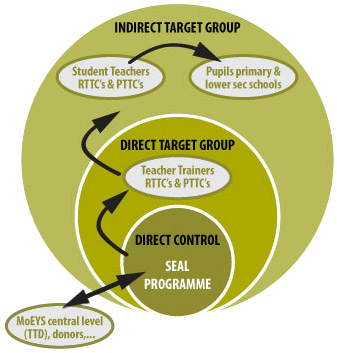
The aim of the SEAL programme is to improve the teaching and learning methodology of graduate teachers from pre-service Teacher Training Centres (TTCs) with a focus on the learning fields of Science as well as Environmental and Agricultural life skills in basic education. Specific encouragement is given to applying student centred approaches, developing critical thinking skills and making education relevant for people’s daily lives. Furthermore a component of using ICT and multimedia in the lessons is part of the programme.
SEAL aims at integrating technological, pedagogical and content knowledge (TPACK).
Target group
- Direct target group
- Teacher trainers science, environment and agriculture
- Primary and lower secondary teachers at practice schools affiliated with the selected TTCs.
- Indirect target group
- Student teachers – at provincial level for primary education and at regional level for lower secondary education
- Pupils of those future teachers
Activities
Under supervision of the Teacher Training Department and with help of working groups of teacher trainers capacity building of teacher trainers, lower secondary and primary school teachers has taken place through:
- Workshops
- Environmental Education
- Science
- How to stimulate creative thinking problem solving skills
- Low-cost experiments
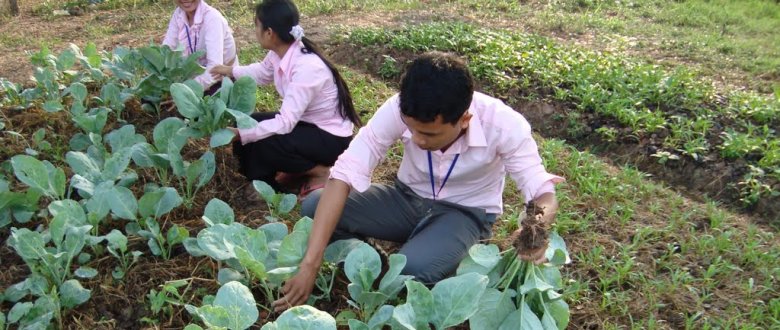
- Agriculture (Organic gardening, Fish and Chicken raising)
- Learner Centred Methodologies
- The use of ICT and multimedia
- Material development for teaching and learning (manuals, posters, DVDs on methodology and content, flash animations) Download
- Lesson observation and Constructive feedback
- Study visits
- Raising environmental awareness
- In addition a MoEYS web portal has been set up for sharing good practices and educational resources.
Context
Two important tendencies and challenges for the educational sector of Cambodia were the base of the SEAL programme:
- The high drop-out rates in basic education make the Cambodian youth vulnerable and more likely to remain in poverty. While the low quality of teaching at primary and secondary schools is one of the main reasons why children drop out of school, the lack of relevance and usefulness of their learning is certainly reinforcing this tendency.
- Closely related to this issue is the increasing migration of youth from rural to urban areas. As children in rural areas face a poor future in rural areas due to the low income generation from agricultural activities, they seek their fortune in cities. Schools play an important role in offering children a better prospect in rural areas but currently fail to do so, partly due to the lack of teaching capacity in life skills.
 “I like studying here at the teacher training centre. I enjoy the physics classes of Mr. Vanna the most. He explains new lesson topics by performing experiments and this helps us to understand difficult topics more easily. I already look forward to explaining this to my pupils during my practical training next month.”
19-year-old Hy Ratheany, second-year student at the Regional Teacher Training Centre of Kampong Cham