
Improvement of Agricultural Extension (ImAgE)
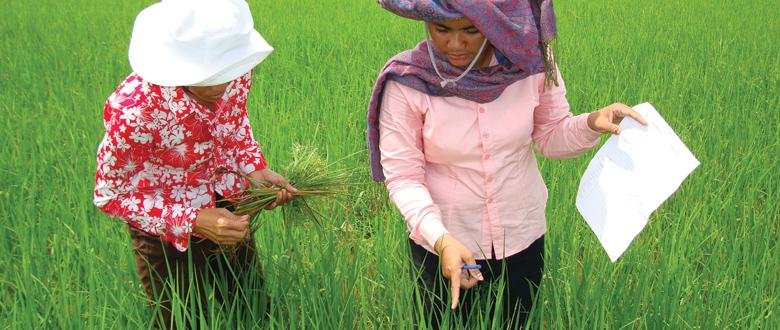
VVOB’s ImAgE programme strengthened agricultural extension services in order to improve farmers’ livelihoods and decrease their vulnerability. More specifically ImAgE encouraged farmers in Cambodia’s Kandal province to adopt and share improved and environmentally friendly agricultural practices. The programme especially reached out to female and young farmers.
This had a double impact. Firstly, the prospect of being a farmer in rural areas becomes more attractive to youth, thereby decreasing the migration to urban areas. Secondly, by increasing family income, parents can pay for the tuition for their children.
The ImAgE programme directly targeted the extension workers of the District Offices of Agriculture (DOA) in Kandal province. ImAgE aimed to strengthen their capacity from within the Provincial Department of Agriculture (PDA) via their Subject Matter Specialists (SMS). Through this capacity building, we gradually reached our indirect target group, the farmers.
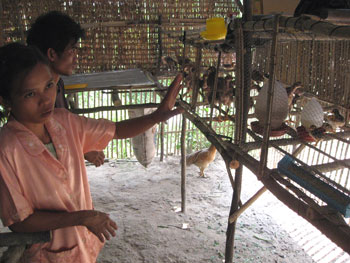
"I can make about US$1,200 every four months, which earns me a net profit of around US$500‐600. On a yearly basis that is US$500 more than last year." says farmer Bun Nov, female member of an ImAgE programme farmer group.
In our pursuit towards our objective, we entered into active partnerships with local Cambodian institutes on provincial and ministerial level, as well as with other donors and agencies working within the agricultural sector.
How we implement ImAgE
At provincial level ImAgE introduced methodologies such as Participative Technology Development (PTD) and the needed skills to apply them. The Office of Agricultural Extension (located within the Provincial Department of Agriculture) provides in turn support to the district extension workers in methodological skills, including PTD, farmer field schools and field demonstrations. The Subject Matter Specialists (also at provincial level) provide the required expertise in their respective fields such as animal health and husbandry, fish farming, vegetable growing and systems of rice intensification.
Participatory Technology Development (PTD) as a framework for extension
PTD refers to the creative process of joint experimentation and research by farmers and development agents (such as extension workers) in discovering ways of improving farmers' livelihoods. Experimentation and innovation are natural and necessary to farmers. Before formal research and extension services existed, farmers' own experimentation allowed adaptation to new situations, to survive and to improve their livelihoods, where conditions were favourable.
This is still the case today, even where farmers have access to external support. Many development projects and extension agencies are appreciating farmers' informal experimentation as a springboard for developing locally appropriate technologies (van Veldhuizen, IDRC). The Institute for Low External Input Agriculture (ILEIA) based in the Netherlands has described PTD as a process between local communities and outside facilitators which involves:
- Gaining a joint understanding of the main characteristics and changes of that particular agro-ecological system;
- Defining priority problems;
- Experimenting locally with a variety of options derived both from indigenous knowledge and from formal science;
- Enhancing experimental capacities and farmer-to-farmer communication.
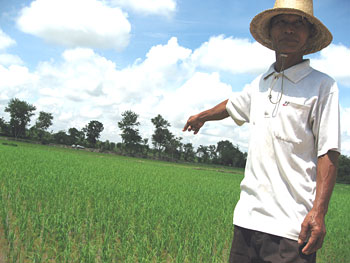
"The other farmers all laughed when they saw my rice field. Now they admire me, I can grow stems as big as a hand or a foot." says Farmer Men Sary, member of an ImAgE Programme farmer group.
So, it’s clear that throughout the entire implementation, the Provincial Department of Agriculture plays an importa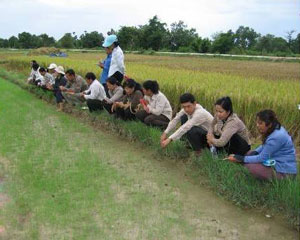 nt role to support the staff of the district offices. It is especially at these district offices where strengthening of capacity is needed since the extension staff still lack technological and methodological skills. A successful capacity increase can then assure the needed participation, quality and flexibility of services offered by the extension workers.
Did you know?
Cambodia continues to rank among the lowest in the region for the Gender Related Development Index (GDI) and Gender Empowerment Measure (GEM). It scores a value of 0.588 in the GDI and ranks 91st out of 109 countries in the GEM, with a value of 0.427.
The gender-related development index (GDI), introduced in Human Development Report 1995, measures achievements in the same dimensions using the same indicators as the human development index (HDI) but captures inequalities in achievement between women and men. It is simply the HDI adjusted downward for gender inequality. The greater the gender disparity in basic human development, the lower is a country's GDI relative to its HDI.
The gender empowerment measure (GEM) reveals whether women take an active part in economic and political life. It tracks the share of seats in parliament held by women; of female legislators, senior officials and managers; and of female professional and technical workers; and the gender disparity in earned income, reflecting economic independence. Differing from the GDI, the GEM exposes inequality in opportunities in selected areas.
At the highest level, quality assurance and dissemination of new technologies is provided by the Department of Agricultural Extension (DAE) of the Ministry of Agriculture, Fisheries and Forestry (MAFF). Furthermore, the ImAgE programme aimed to support the DAE by setting up an on-line platform for sharing and promoting good practices, also outside of Kandal province.
Finally, the training skills and materials that ImAgE developed were adapted for use at the Teacher Training Centres in the SEAL programme. The developed expertise by the District Office of Agriculture provides a valuable input for SEAL’s agriculture life skills component. This synergy leads to a strengthening of the teachers at the Teacher Training Centres and ultimately targets youth at schools.
As with our SEAL programme, we implement ImAgE in two phases – pilot and mainstreaming. The number of targeted districts in the pilot phase is limited to three in order to keep focused on quality assurance. Likewise, the number of villages where pilot activities take place is also kept low (15 in total) for the same reason. Their extension workers are coached in methods to promote the development or improvement of new agricultural practices. Emphasis is placed on experimentation following the Participative Technology Development (PTD) model. This is done under the guidance of the officers and specialists of the Provincial Department of Agriculture.
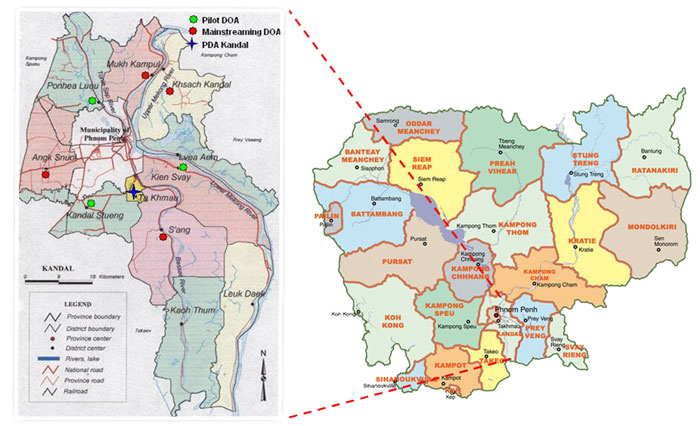
During the mainstreaming phase, good practices are implemented on a wider scale by involving more districts and by supporting the formation of more farmer groups. Moreover, the PTD technique can continue to be applied in the mainstreaming phases so that the technology development becomes an ongoing improvement process.
Crunching numbers: ImAgE’s mainstreaming phase
In the mainstreaming stage the number of targeted districts increases to 7 while the number of villages rises to an estimated 140. The number of provincial and district extension workers that can be reached in this phase is 11 and 24 respectively, or a total of 35 extension workers.
Simultaneously with the increase of the number of villages, the total number of farmers that can be reached rises to about 500. We aim to include 50% female farmers and 15% young farmers (up to the age of 26).
Provided district extension workers remain active in their districts also after the handover of the programme, the total of potential villages reached in the longer term within the 7 districts amounts to 907. With a total population of 761,508 this constitutes 8% of the rural population in Cambodia.