Past Projects

Learner Centred Methodology

LCM at work

VVOB’s Learner Centred Methodology (LCM) project started in 2004. It focused on strengthening the methodology of primary school teachers in the provinces of Siem Reap, Oddar Meanchey and Kampong Cham. By involving, challenging and motivating students, and by making lessons more interactive, the LCM project aimed at stimulating primary school students to actively attend classes. It also encouraged parents to support their children in continuing to attend school and it built teacher capacity by empowering the teachers, giving them support on implementing new methodologies and increasing their involvement.

The LCM methodology was introduced at the Provincial Teacher Training Centre of Siem Reap. Special training content and materials were developed which resulted in a manual for pre-service teacher training. Other examples include digital materials such as task sheets on LCM and a DVD box with movie clips depicting teaching examples and with corresponding question sheets that prompt the student to analyse the fragments.

Cross‐curricular project: the market

The directors of the schools were trained on how to support their teachers and they too received a manual, about school management. Also the Cross-curricular project: the market parents and the community were involved in the teaching process in which cross-curricular themes and life skills integration were brought to their attention. Examples include environment, HIV/Aids and gender.


From 2008 onwards, the project’s activities focused on consolidation by setting up a sustainable structure for the continued and practically-oriented implementation of LCM in the pilot schools. At the same time, mainstreaming activities took place through nation-wide training at all Provincial Teacher Training Centres. This happened in close cooperation with other donors and NGOs. The published LCM manual and subsequent DVD box with teaching examples were approved by the Ministry of Education, Youth and Sport. Both were distributed nation-wide.

In 2009 the project was handed over to the partners after a positive evaluation by a team of external evaluators and members of the Ministry of Education, Youth and Sport.

Strengthening Health Education

Building capacity of teachers to integrate health topics into their lesson plans and teaching practices was the aim of this project – then called School Health Promotion. This started in 2005 and took place at the Provincial and Regional Teacher Training Centres of Battambang. By training the trainers and trainees at pre-service level, the acquired knowledge and skills are directly transferred to the staff of the primary and lower secondary application schools, resulting in promoting improved health at these schools.


Strengthening health education with visual materials

As one of the results of the project, four manuals for teacher trainers and teachers were developed, covering hygiene, addiction, sexuality & reproductive health, first aid & road safety, mental health, health education methodology, and school health management. Teaching materials corresponding with these topics were also developed.

During mid-term the project was remodelled into targeting specifically the teacher trainers on subjects that already include health education components. It was renamed to ‘Strengthening Health Education’ and focused increasingly on the integration of a selection of the modules into the curriculum of the Teacher Training Centres. The project continued with the capacity building of teacher trainers of biology and home economics at the Regional and Provincial Teacher Training Centres. It also achieved donor coordination by networking with national health organisations and with health departments of international donors.

The project will be handed over to the partners at the end of 2010.

Improvement of Mathematics and Physics teacher training

The low‐cost laboratory at Kampong Cham

Starting in 2004, VVOB’s project focused on teacher training and curriculum development for maths and physics at the Regional Teacher Training Centre of Kampong Cham province. By training the teacher trainers on teaching methodology, subject knowledge and material development, the student teachers directly benefit and provide an improved quality education in lower secondary schools. A lot of attention was given to implementing a more learner centred education, including conducting experiments. The project also focused on the development of teaching manuals on maths and physics to align with the new curriculum.

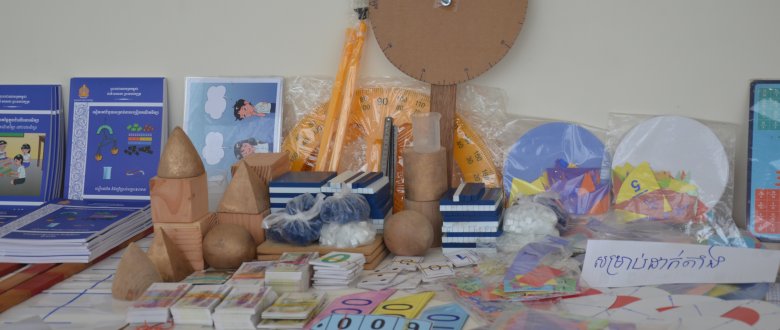
As part of the project, a laboratory was set up and equipped at the Regional Teacher Training Centre of Kampong Cham. Maths & Physics Teachers were trained on how to use the lab and conduct experiments in their daily classes. The teachers and teacher trainers also learned how to produce their own self-made, low-cost materials to support their teaching. This clearly makes the learning process a much more enjoyable and stimulating experience for the students.

A workshop on magnetism with self‐made materials

By organising yearly science events, the 12 pilot schools managed to increase the involvement of parents in their children’s education. As part of the project, also the school directors were trained to follow-up and support teaching and learning activities of the teachers. Finally, during the last phase of the project, the efforts focused on mainstreaming the results nationwide to maths and physics teachers at the other 5 Regional Teacher Training Centres. Hereby the project’s indirect target group was expanded to the students of all RTTCs and their practice schools.

The project was handed over to the partner in 2008 and was positively evaluated by a team of external evaluators including members of the Ministry of Education, Youth and Sport.


Open Resource Centre

Developing one’s own teaching materials - work and fun in one.

VVOB’s Open Resource Centre (ORC) project was set up in 2006 as an extension of the project on Learner Centred Methodology. Implemented at the Provincial Teacher Training Centres in Siem Reap and Kampong Cham, its objective was to offer teachers the possibility to develop (digital) teaching materials and to use them to support new education methodologies. ICT and multimedia formed a major component in this project. This is based on the approach that ICT allows the different players in the educational field to develop teaching and learning resources and to teach and learn in a more learner centred way.

The activities were directed to the teacher trainers and teachers, but the final beneficiaries were the student teachers. By focusing on the Provincial Teacher Training Centre, there will be a continuous improved training for the future primary school teachers.

Using computers as an educational resource

As a result of the project, a computer room was set up for student teachers and teacher trainers in the teacher trainer college. Internet connection is available, as well as an online database with teaching materials. These resources have become import tools for the preparation of classes, self-study and computer lessons.

The project also focused on the development as well as the use of teaching materials to implement learner centred methodology. To this effect, a DVD box with teaching examples was created in collaboration with our Learner Centred Development project. Other examples include educational games, exercises, pictures, lesson plans, worksheets, educational software, and so on. Also visual aids for use in classrooms, such as interactive educational banners, were put together.

www.krou.org
Every teacher’s dream: www.krou.org

Finally, in order to promote the ORC activities and materials to a broader target group, an interactive, website was developed at WWW.KROU.ORG. This educational portal contains information about activities and a database with downloadable materials collected by the project team and developed by the different target groups. With KROU.ORG teachers and teacher trainers have a platform where they can exchange materials over the internet, upload and download teaching resources, tools, good practices and so on. The publication of these materials on the web portal happens with the approval of the Ministry of Education, allowing them to be distributed to other PTTCs nationwide.

The project was handed over to the partner in 2009 (including a computer room with 20 computers) and was positively evaluated by a team of external evaluators including members of the Ministry of Education, Youth and Sport.